Showing posts with label Free Trade. Show all posts

Monday, September 16, 2013

Multi-national "wish lists" in advance of EU-US free trade pact negotiations

In advance of TPP-style talks between the US and EU, corporations are already filing "wish lists" to ditch pesticide and food standard regulations and set up the same "investor-state resolution" mechanisms found in NAFTA and TPP. In this New York Times article Public Citizen's Lori Wallach notes: “What they [multinationals] consider trade irritants, we consider the most important consumer, health, environmental, privacy, financial stability safeguards on either side of the Atlantic." Gutting regulations is "an effort to achieve through trade what that they could not achieve through democratic processes domestically.”

Read more...

Sunday, September 8, 2013

Create a TPP-Free Zone where you live!

Taking to the streets in
Madison WI to derail fast-track
and the TPP
Don’t let the Trans-Pacific Partnership take away our democratic rights as individuals and as a community. Now is the time to organize to create a "TPP-Free Zone" in your town, city, or county.

If you are not yet familiar with the Trans-Pacific Partnership (TPP), now is the time to find out. TPP is a massive trade pact being negotiated between the United States and 12 or more Pacific Rim countries including Japan. It is being written by and for the transnational corporate elite and is cloaked in extreme secrecy. No member of Congress has been allowed to participate in the negotiations, yet President Obama wants Congress to approve the TPP under Fast Track authority which would only allow for an up or down vote on this corporate-negotiated trade deal.

Like other free trade agreements, TPP’s provisions will trump local, state and federal laws and regulations whenever they interfere with “free” trade—free, that is, for corporations, but very costly for the rest of us. Like with NAFTA and CAFTA, the TPP’s investor provisions would privilege the “right” to profit—even the right to anticipated future profits—over democratic decision-making.

From leaked text and previous trade agreements, it is clear that the TPP would --
•  Undermine financial industry regulations needed to prevent another meltdown
•  Restrict free use of the internet
•  Greatly expand copyright protection
•  Dismantle “Buy Local” and “Buy American” preferences which promote local business
•  Restrict use of cheaper generic drugs
•  Challenge food safety regulations including GMO labeling
•  Delay action on climate change, if not prevent it outright
•  Prevent government limits on the export of fracked natural gas, as well as coal and water
•  Allow the U.S. and countries to be sued by foreign corporations for lost profits as a result of laws and regulations, even those protecting health and the environment

Yet, labor, environmental, health care, internet/free press, climate justice, green energy and democracy organizations have been excluded from the negotiations. They cannot see the text, nor comment on it despite the impact of the TPP on all these issues.

We know that most members of Congress are bought lock, stock and barrel by the corporations and Wall Street. So while we must  raise our voices against Congress agreeing to  fast track the TPP,  we must not end our advocacy at their doorstep. We must take our resistance to a world ruled of,  for and by the corporations right to our doorstep, right to where we live. We must assert our right to self-governance, to a nation of, for and by the people.

How can we do this? Many communities across the country have passed rights-based laws, establishing their right to self-governance, asserting their right to a clean and safe environment, establishing the rights of nature to thrive as ecosystems, and denying corporations the right to use the US Constitution or state constitutions to challenge these fundamental rights.

Now it is time to assert our right to a local economy, free of rules negotiated in secret, without our consent, by transnational corporations for their own benefit.  It is time to say we will not abide by decisions reached by secret trade tribunals which will impact our health and safety when we do not even have a right to be represented. It is time to pass local laws to create TPP Free Zones.

It is time to build a democratic movement of resistance.  It is time to start right where we live, in our own community.  It is time to say to President Obama and to the corporations which are sitting at the negotiating table

“If you, our unelected representatives, create this corporate-driven monstrosity and then go to Congress and get a rubber stamp, WE WILL NOT OBEY.”

We will be following in the footsteps of the successful resistance to an earlier trade agreement, the Multilateral Agreement on Investment. This was the first global mobilization against a proposed trade agreement and an important part of the campaign was organizing locally.  In the U.S. and Canada, some municipalities declared themselves to be MAI Free Zones.  The MAI was defeated in 1998.

We must organize to defeat the TPP and if it is not defeated, then we can do no other than say “We will not obey.”

For information on creating a TPP-Free Zone, see this page on the AfD website.


Read more...

Monday, July 22, 2013

Info on the Trans-Pacific Partnership

Jessica Desvarieux of The Real News talks to Lori Wallach of Public Citizen's Global Trade Watch about why the Trans-Pacific Partnership is not about traditional trade regulations such as tariffs, but all about expanding corporate rights and privileges. Learn about the few sections of the TPP that have been leaked to the public, why negotiations and content of the agreement are being kept secret, and what a signed agreement would mean for food safety, internet freedom, drug costs, and other basic components of public health and economic justice.


Read more...

Monday, July 15, 2013

Come to the Earth Democracy Conference at the Democracy Convention, August 7-11, in Madison

National and international policies based on neoliberal economics, corporate globalization, and "free" trade which aim to commodify, privatize and profit from almost every aspect of nature are destroying local communities and cultures, and the ecosystems on which all life depends. Earth Democracy is juxtaposed to this system and is grounded in the inherent rights of living beings and Mother Earth.

The Earth Democracy Conference will be one of several tracks at this year's Democracy Convention, to be held August 7 through 11 at Madison College, Madison Wisconsin. Earth Democracy  builds on the declaration adopted by the Ecojustice People's Movement Assembly at the 2010 US Social Forum which states: "We support the conclusion that only by 'living well', in harmony with each other and with Mother Earth, rather than 'living better,' based on an economic system of unlimited growth, dominance and exploitation, will the people of this planet not only survive but thrive."

The Earth Democracy Conference will bring together people who are working on the frontlines of the ecojustice movement to:

  • democratize the electric grid and finance local renewable energy
  • expose the corporatization of the "green" economy agenda
  • recognize water as a fundamental right of people and nature
  • combat global warming through creative action
  • overcome corporate influence on school curricula and pursue earth-friendly curricula

Sessions include (full descriptions coming soon!): 
Thursday, August 8th- Sunday, August 11th
Awakening the Dreamer Symposium with The Pachamama Alliance Community

Action Tool Kit for Earth Democracy with Randa Solick and Ellen Murtha, Women’s International League for Peace and Freedom

Guardianship of Future Generations & Rights and Responsibilities of Present Generations/Writing Earth Rights into Law with Carolyn Raffensperger, Science and Environmental Health Network and Linda Sheehan, Earth Law Center Energy

Injustice & Environmental Racism: How Dirty Energy Impacts Communities with Mike Ewall Energy Justice Network

Teaching Earth Democracy with Erica Krug, Dan Walkner, and Susan Friess, Madison Public School Teachers

Powering up for People, Peace and the Planet: Re-envisioning the Climate Movement: Building Resistance, Collaboration, Transformation with Victor Wallis, writer on ecology and politics, Sherri Mitchell, Land Peace Foundation (Maine), Stephanie Kimball, 350.org-Madison, and Jill Stein

The Climate of Justice: Asserting our Human, Civil and Earth Rights with Lauren Regan, Civil Liberties Defense Center, Sherri Mitchell, and Jill Stein

Activist Training: Know Your Rights with Lauren Regan

Big Extraction/Big Pollution/Bigger Resistance with representatives from frontline Indigenous and local communities fighting the XL and Enbridge pipelines, sand pits, Penokee Hills Taconite Mine, Rio Tinto Eagle Mine and high capacity water pumping and David Cobb on community rights vs. corporate rights

Re-Envisioning the Climate Movement: Building Resistance, Collaboration, Transformation with Victor Wallis, Sherri Mitchell, and Jill Stein

Water for Life: Local Ordinances to Protect Water, Springs and Rivers with Jane Goddard Center for Earth Jurisprudence and Linda Sheehan

Contours of an Ecologically Sound Economy with Chris Wallace, writer on the ecological crisis and the commons, Rachel Smolker Biofuelwatch, and Mike Ewall

Stop the World’s Largest Trade Agreement’s Harm to the Earth, Agriculture and Food Systems with Jim Goodman, Family Farm Defenders, George Naylor, National Family Farm Coalition and others to be announced

Next Stage: Building the Movement for People, Peace and the Planet – From #Fearless Summer to Fearless All Year Round – dynamic group participant discussion

Alliance for Democracy, Green Action, and the Women's International League for Peace and Freedom thare the principal conveners of the Earth Democracy Conference. Contact Nancy Price at nancytprice39@gmail.com for more info.

Read more...

Thursday, June 20, 2013

A postcard call to action on TPP

The Alliance's Portland chapter has produced a short and to-the-point postcard handout with info and actions to stop the Trans-Pacific Partnership. If you're organizing on this issue, you will want to have these to encourage people to take action against any upcoming attempt to reauthorize Fast Track, and to demand that the text of the agreement be made public.

The ultimate goal? Democratically-determined trade policies that protect local economies and the rights of people and nature.

There is more info on TPP, including video and other printable resources, on our website.

Read more...

Thursday, June 13, 2013

Sen. Warren goes to bat for democracy on the TPP

Senator Elizabeth Warren (D-Mass) may be picking her battles in her first term, but she's seized on a good one--the abysmal lack of transparency surrounding the Trans Pacific Partnership trade negotiations.

In a letter sent today to Michael Froman, Assistant to the President, she asks whether the White House will make the bracketed text of the TPP public (the bracketed text would include not only proposed agreement language from the US, but also proposed language from other negotiating countries) or a scrubbed bracketed version, as the Bush administration did in Free Trade Area of the Americas negotiating.

Warren generally complimented the Obama administration on its openness but said that TPP negotiations are an exception to transparency and inclusion.

Warren's letter notes that she has "heard the argument that transparency would undermine the Administration's policy to complete the trade agreement because public opposition would be significant. This argument is exactly backwards. If transparency would lead to widespread public opposition to a trade agreement then that trade agreement should not be the policy of the United States. I believe in transparency and democracy, and I think the US Trade Representative (USTR) should too."

You can read about the letter here, with a link to the original text at the end.

Read more...

Wednesday, May 8, 2013

Steps forward and back on democratizing trade


Two days ago, Corporate Europe Observatory, the Transnational Institute and the Council of Canadians warned that the proposed CETA trade pact between Canada and the EU would grant energy companies far-reaching rights to challenge franking bans and regulations. These investor-state disputes are used by multinationals to challenge and overturn democratically-enacted laws protecting labor, the environment, public health, or any other common good that gets in the way of the supposed "right" to make money. The three groups are urging the EU, member states and the Canadian government not to include an investor-state dispute settlement system in CETA.

Under the North American Free Trade Agreement (NAFTA) there already exists a precedent for legal challenges to fracking bans and regulations that could be the state of things to come in Europe. For instance, US energy firm Lone Pine Resources Inc., is challenging a moratorium on fracking in the Canadian province of Quebec, suing the Canadian government for compensation.

EU member states already have experience with investor-state disputes undermining green energy and environmental protection policies. Germany is currently being sued by energy company Vattenfall because of the country's exit from nuclear power. Vattenfall is seeking EUR3.7 billion in compensation for lost profits. EU - Canada CETA negotiations were launched at a bilateral summit in May 2009 and negotiators hope to conclude a deal before the summer.

More positively, 12 Latin American governments gathered in Guayaquil, Ecuador at the end of April to craft a common response to investor-state suits. 

As Public Citizen reported, "Ecuador, the host of [this gathering] has taken a particularly hard battering from the investor-state system enshrined in NAFTA-style Free Trade Agreements (FTAs) and Bilateral Investment Treaties (BITs)," including a ruling from one tribunal to hand $2.4 billion to Occidental Petroleum after Oxy broke Ecuador's hydrocarbons law, while confronting a ruling from another tribunal that the government should breach its own Constitution and block the enforcement of an $18 billion court ruling against Chevron for massive pollution of the Amazon.

"Seven of the governments present signed a declaration to coordinate efforts in seeking to replace the investor-state regime with an alternative investment framework that respects sovereignty, democracy, and public wellbeing, and announced the launch of an intergovernmental commission based in Latin America to audit investor-state tribunals, draft alternative investment agreements, and collaborate in strategies for reform…. Representatives from the remaining five governments participated as observers and are now taking the declaration back to their capitals to discuss joining the emerging Latin American coalition."

These efforts are matched around the world. Investor-state provisions in the Trans-Pacific Partnership are a sticking point for Australia, while India and South Africa are also eyeing changes in policy regarding investor-state disputes. Clearly, there is widespread grassroots pressure to end this egregious example of corporate rule.

Read more...

Monday, April 8, 2013

Worth reading: How the TransPacific Partnership undermines democracy

Here's a very comprehensive rundown on what we know about the Trans-Pacific Partnership, a monster trade deal that involves nearly a dozen nations on both sides of the Pacific. Authors Margaret Flowers and Kevin Zeese note that from NAFTA on, international trade deals have led to job loss and economic disruption, and warn readers to beware any talk of Congressional "Trade Promotion Authority," the euphemism that the Obama Administration, which is pushing this deal, has seized on to avoid the now toxic term "Fast Track."

Read more...

Thursday, March 14, 2013

What you need to know about Fast Track Authority


As part of the push to approve the Trans-Pacific Partnership, President Obama has now stated that he will ask Congress for Fast Track Authority (FTA). Fast Track Authority was first granted to President Ford (first proposed by President Nixon but he resigned prior to congressional approval) and has been used to enact almost every Free Trade Agreement since. Note that FTA is not required nor requested to enact traditional trade agreements which deal with tariffs and quotas; but because of the complexity of Free Trade Agreements, FTA is seen as required to enact Free Trade Agreements. A distinguishing characteristic of these agreements is that they largely involve non-tariff issues.

FTA allows the president to enter into and sign free trade agreements prior to any congressional approval. These agreements become law when the president signs them.  For all other laws, congress must give its approval first and then when the president signs, it becomes law. FTA turns that standard democratic process on its head.

Under FTA, Congress is not allowed to be part of the negotiations. After the negotiations are completed and the agreement has received the presidential signature, the implementing legislation, which includes changes to American law necessitated by the agreement, is presented to first the House for their vote and then to the Senate for their vote. Neither chamber is allowed to make any changes to the implementing legislation. Both chambers are required to vote within 90 days of the presidential presentation of the implementing legislation.

Such rigid timelines for congressional approval means that neither Congress nor the public have adequate time to read and analyze these enormously complicated detailed agreements, agreements which will have significant impacts on labor public health the environment agriculture, financial regulation and more. And these rigid timelines are imposed on congress in spite of the fact that the president (and the corporate lobbyists) will have spend years negotiating the agreement.

Democracy demands that congress not delegate its constitutional responsibility to negotiate trade agreements to the president. Such delegation is a major power grab on the part of the president. We need to demand that congress not approve Fast Track Authority.

There is an excellent e-book from Public Citizen called The Rise and Fall of Fast Track Authority.  This is what it says about the provisions/timeline of FTA:

Core Aspects of Fast Track Trade-Authority Delegation

  • Allowed the executive branch to select countries for, set the substance of, negotiate and then sign trade agreements – all before Congress had a vote on the matter.
  • Required the executive branch to notify Congress 90 calendar days before signing and entering into an agreement. 127
  • Empowered the executive branch to write lengthy implementing legislation for each pact on its own, without committee mark ups. That is to say, the process circumvented normal congressional processes. These executive-authored bills altered wide swaths of U.S. law to conform domestic policy to each agreement's requirements, and formally adopted the agreement texts as U.S. law. As a concession to congressional decorum, the executive branch agreed to participate in "non" or "mock" hearings and markups of the legislation by the trade committees. However, this is a practice, not a requirement. In 2008, President Bush chose to ignore this practice and exercise the president's Fast Track right to force a vote on an agreement by submitting it without informal agreement on timing or mock mark ups, despite congressional leaders' objections to the pact's submission at that time. 128 
  • Once the executive branch transferred such a bill, the agreement itself, and various supporting materials to Congress, the House and Senate were required to vote on the implementing legislation and the attached agreement within 90 legislative days.
  • Such bills were automatically referred to the House Ways & Means and Senate Finance Committees. (In the 2002 Fast Track bill, the House and Senate Agriculture committees also got a formal referral). However, if a committee failed to report out the bill within 45 legislative days from when the president submitted the legislation to Congress, the bill was automatically discharged to the floor for a vote.
  • A House floor vote was required no later than 15 legislative days after the bill was reported or discharged from committee. Thus, within 60 legislative days, the House was required to vote on whatever agreement the president had signed, and whatever legislation changing U.S. laws he had written to implement the package.
  • The Finance Committee was allowed an additional 15 days after the House vote, at which time the bill was automatically discharged to the Senate floor for a vote required within 15 legislative days.
  • The floor votes in both the House and Senate were highly privileged. Normal congressional floor procedures were waived, including Senate unanimous consent, debate and cloture rules, and no amendments were allowed. Debate was limited to 20 hours – even in the Senate.
  • Once the president provided Congress with notice of his intent to sign an agreement, he was authorized to sign after 90 calendar days. However, there was no mandatory timeline for him to submit formal implementing legislation and start the 90-legislative day vote clock. Thus, an agreement's legal text finalized just minutes before the delegation authority expired could be sent to Congress even years later.
  • Once a president submitted an agreement under Fast Track, that agreement's Fast Track treatment was "used up." If Congress adjourned before the mandatory vote clock ran out or if Congress voted against the agreement, Fast Track for that agreement expired. If it were to be submitted again for a later vote, normal congressional floor procedures would apply. 129 
  • An advisory-committee system was established to obtain private sector input on trade-agreement negotiations from presidentially appointed advisors. 130  This system is organized by sector and industry and included 700 advisors comprised mainly of industry representatives. Throughout trade talks, these individuals obtained special access to confidential negotiating documents to which most members of Congress and the public have no access. Additionally, they have regular access to executive-branch negotiators and must file reports on proposed trade agreements. The Fast Track legislation listed committees for numerous sectors, but not consumer, health, environmental or other public interests. 131 
  • The 1974 Fast Track also elevated the Special Trade Representative (STR) to the cabinet level, and required the Executive Office to house the agency. While other cabinet-level positions tend to be responsive to a pre-defined constituency (Agriculture and farmers, for instance), the STR was unique in that its only real constituency was the president, the gatekeeper committees of Congress, and the hundreds of trade advisory committees. And its main goal was proliferation of trade negotiations. The 1979 Fast Track changed the name of the STR to the U.S. Trade Representative.
  • The 2002 Fast Track created an additional requirement for 90-day notice to the gatekeeper committees before negotiations could begin, but neither the gatekeepers nor the executive were required to take any further action after receiving this notice. 132

Read more...

Friday, February 15, 2013

Gearing up to stop the Trans-Pacific Partnership

President Obama proposed some intriguing and positive programs in the State of the Union speech--public preschool, a hike in the minimum wage, and measures to prevent gun violence. In a country where policy is democratically determined by representatives who truly act on behalf of the common good and the wishes of their constituents, those kind of ideas could really go somewhere.

Unfortunately, it would be irresponsibly optimistic to think that new laws on public safety will be determined out of reach of the gun lobby, or we'll see anything close to a national living wage when big-box retail, fast food, and other low-wage employers remain politically powerful.

That's why it was very disappointing to hear Obama call for a renewed push for the Trans-Pacific Partnership trade agreement. We've written a lot about TPP and the damage it could do to local and national sovereignty and laws that protect workers' rights, the environment, public health, and jobs. That's why on either side of the Pacific, citizens' groups of all kinds are opposed to instituting this compact.

It takes some work to mine profit out of universal background checks and preschools, but TPP is one thing that multinationals can get behind in a big way. And they will. Why not? They already have a much better idea of what's in the agreement, thanks to access to the negotiating process that even members of Congress lack.

We need to stop TPP and one way to start is to get our communities informed about what's wrong with so-called "free trade." Please take a look at this latest edition of Populist Dialogues, featuring Arthur Stamoulis of the Citizens Trade Campaign, and consider sharing it with friends online and with your local community access cable station.


Read more...

Friday, December 28, 2012

Join Alliance for Democracy in 2013

As we build for 2013, we welcome your member support! Check out our 2012 report, and then please consider supporting the upcoming year's organizing by joining Alliance for Democracy. Members receive a subscription to our newsletter, Justice Rising, and the satisfaction of helping end corporate rule from the grassroots up.

If you can make a larger contribution, we'll thank you by sending you a dvd of one of the following Populist Dialogues programs. Select one dvd for a donation of $50, two for $100 or all three for $150. When you give online you'll be able to select the show you'd like. If you have questions, or want to learn more about sharing the show on your local community cable station, please contact us in the office--email or call 781-894-1179.

12-46: Escaping the Great Recession with Public Banking
Guest Ellen Hodgson Brown, author of The Web of Debt and founder of the Public Banking Institute,  discusses the advantages of public banking in the United States and around the world. She reviews how money is created, how the Federal Reserve was created, various types of public banks and how their are structured, why some nations have escaped the Great Recession, how America could save its postal service, and how public banking institution could be used as a land bank to address the under-water property and foreclosure problems. First broadcast 11-11-12

12-44: Capitalism of the Olympic Games
Jules Boykoff, associate professor of political science at Pacific University, discusses the recent London Summer Olympics in terms of what he calls Celebration Capitalism. He also talks about the origins of the International Olympic Committee, costs for host cities (both economic and political), who sponsors and benefits from the games, the opposition which develops, media response to that opposition, and the militarization of public spaces including the concept of “Total Policing.” First broadcast 10-28-12

12-41: TransPacific Partnership and "Free Trade"
Guest Elizabeth Swager is Asst Director of Oregon Fair Trade Campaign. She talks about her role in the enactment of Portland Oregon's sweat-free procurement ordinance, designed to protect foreign factory workers. She goes on to review past "free-trade agreements" (NAFTA, Panama, Columbia and South Korea) and their effects on American jobs losses, tax havens and challenges to laws and regulations as a result of investor protection clauses. The TransPacific Partnership is then discussed as a "NAFTA on steroids." This agreement is being negotiated in super secrecy, except for a leaked chapter, which give us a look at how corporate-driven the TPP is. The show includes a petition calling for transparency in the TPP negotiations. First broadcast date:  Oct. 7, 2012      

Read more...

Tuesday, December 4, 2012

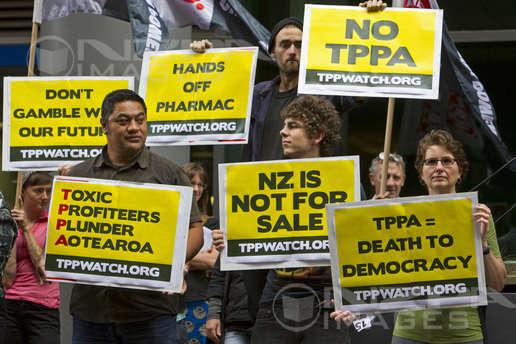
AfD Portland marches against TPP

Alliance for Democracy Oregon members traveled by bus to the Peace Arch in Blaine WA on Dec 3, 2012 for a rally and summit with others opposing the TransPacific Partnership (TPP) from Washington state and from Canada.  They joined friends from the Oregon Fair Trade Campaign and many unions in Oregon to make the trip. Here's AfD members Greg Magolis, David Delk (who is also chapter president and AfD's national co-chair) and Barbara Council. And yes, that is a giant posterior-shaped balloon hoisting a slogan into the air.

All kidding aside, summit participants decided to get at least 1,000 organization sign-ons to a tri-party statement opposing the TPP. Negotiations for this deal have been carried on in secret, with even Congress locked out of the process. Lack of transparency is only one concern with the TPP--it has the potential to undermine democratically-determined laws on public health, "Buy American" compacts, and the environment.

For more rally pictures (and a view of the Portland chapter in action this year) see this page on their website.

Read more...

Wednesday, September 12, 2012

Blockade and balloons protest secretive TPP negotiations in Virginia

From Op-Ed News:
Two people were detained this morning after a tense stand off with police while blockading international trade negotiators from entering the Lansdowne Resort, site of the secretive Trans Pacific Partnership negotiations takingplace this week. Other activists greeted the arriving international negotiators with a 75-foot high banner suspended by weather balloons shaped like giant buttocks that read "Free Trade My Ass: Flush the TPP."

A rapidly growing movement is organizing to oppose the unprecedented lack of transparency surrounding the Obama Administrations handling of the TPP discussions. While 600 corporate lobbyists have been allowed access to and input on the draft texts from the beginning of negotiations three years ago, the public and even members of US Congress have not been allowed to see what is being proposed on their behalf.

"People need to know that the Trans Pacific Partnership is being negotiated in secret to hide the content. The TPP will redefine the terms of trade in ways that give corporations power over nations, makes them unaccountable and threatens the health of people and the future of the planet," said Baltimore native Dr. Margaret Flowers, co-director of ItsOurEconomy.us, as she dangled by a climbing harness 20 feet above the pavement and dozens of agitated police officers and sheriff's deputes. Flowers is a medical doctor and said she was moved to take action in particular because she is concerned about the likelihood that the TPP would increase drug prices by expanding corporate patent rights.

Police responded aggressively at first to the blockade, threatening to taze the metal poles suspending Flowers and to pepper spray the mother of three into compliance. Confused trade negotiators abandoned cars and attempted to walktowards the hotel complex. Stymied by how to safely remove her and open the roadway, police representatives eventually agreed to release Flowers if she lowered herself on her own accord.

Laurel Sutherlin of Rainforest Action Network, one of the organizations supporting this week's demonstrations, said "The TPP is called a 'trade agreement,' but in actuality it is a long-dreamed-of template for implementing a binding system of global corporate governance. It is outrageous that civil disobedience like this is necessary to ensure the public's voice is included in these discussions. The stakes are just too high for the world's environment as well as for farmers, workers and internet freedom for these decisions to be made behind closed doors."

Today's actions follow a colorful rally on Sunday at the same location that was  endorsed by dozens of regional and national environmental, labor and social justice organizations . Members of this diverse coalition, upset by the TPP's complete lack of transparency, have orchestrated a series of demonstrations throughout the week of negotiations.

In 2008, candidate Obama promised that as president he would renegotiate NAFTA with Canada and Mexico with new terms favorable to the United States. Now his administration is negotiating one of the largest corporate trade agreements in history, that would outsource jobs, lower wages and undermine environmental, consumer and labor laws.

Many predict the Trans-Pacific Partnership would do even more harm to U.S. employment than NAFTA. The TPP is being negotiated in secret by the United States, Australia, Brunei, Chile, New Zealand, Peru, Singapore, Malaysia and Vietnam. It contains an  unusual provision, a docking agreement, which allows  other countries to join. This October, Canada and Mexico are expected join the TPP. Later, Japan and China will likely join but it will almost certainly not stop there. The TPP could set the standard for worldwide trade--a major reshuffling of our social contract with almost no public participation.

photo courtesy Rainforest Action Network

Read more...

Thursday, September 6, 2012

Sample letter to the editor on the Trans-Pacific Partnership

Letter to the editor are one of the most-read sections of the paper, and an excellent way to get the public informed and interested in issues that might not make it into the mainstream media.

Here's a model letter to the editor on the Trans-Pacific Partnership, written by a member of the Alliance's North Bridge (Concord, MA) chapter--a timely issue since Round 14 of negotiations are underway through September 15 in Leesburg, Virginia.

Feel free to adapt this letter to local concerns--job losses overseas? A congress member who's bad (or good) on fair trade issues? Strong local support for labor or environmental regulations that might be undercut by this agreement?

If you get your letter published, let us know and we'll link to it here and on our Facebook page.

For the past two years, the nations of the Pacific Rim (including the United States) have been negotiating a massive "trade" agreement called the Trans-Pacific Partnership (TPP). The proceedings have been kept secret from Congress and the public, but representatives of the major multi-national corporations are primary participants. They are developing a new world order that will raise corporate rights above those of people and governments. Leaks reveal it to be a wish list of corporate giveaways like those from NAFTA and the World Trade Organization, only much more so. Its effects would be to:

1. Severely limit the ability of governments at all levels to regulate foreign corporations operating within the United States. Indeed, it would give them greater rights than domestic firms.

2. Provide American companies with even greater incentives to ship jobs overseas to countries with low wages and weak environmental laws.

3. Allow foreign corporations to sue governments for any laws that reduce potential future profits. These include laws for consumer, labor, or environmental protection and that give buy-local preferences. These would be tried in special international trade tribunals whose judges are the same attorneys that work for the multi-national corporations. History so far has shown that the corporations always win these cases in these biased courts.

Just as with similar agreements, the plan is to present it to Congress for a rapid vote before its full implications can be digested and debated. This massive usurpation of our rights to the altar of corporate profits and power must be stopped. Congress and citizens must insist that these negotiating sessions for the TPP be opened up to full public scrutiny and exposed as the giant corporate giveaway that they are.

Read more...

Monday, June 25, 2012

Details emerge on Trans-Pacific Partnership

Few details have emerged as to what might be part of the Trans-Pacific Partnership trade pact, currently in negotiation between the US and eight Pacific countries. Now a leaked draft agreement shows the US moving to contradict 2008 campaign promises on trade. The TPP would allow foreign corporations operating in the U.S. to appeal key regulations to an international tribunal, and that body would have the power to override U.S. law and issue penalties for failure to comply with its ruling. On June 14, Democracy Now! interviewed Lori Wallach, director of Public Citizen’s Global Trade Watch, a fair trade group that posted the leaked documents on its website. Wallach called the agreement "a 'one-percenter' power tool that could rip up our basic needs and rights."


Read more...

Tuesday, April 17, 2012

Multiple countries are rejecting investor state dispute settlement clauses in free trade agreements

by Janet Eaton

There appears to be a growing awareness that NAFTA-style foreign investor privileges and their private "investor-state dispute system [ISD]", which have been among the most controversial aspects of past US trade deals, should be rejected in trade and investment agreements. (ISDs allow corporations to sue to overturn local or national regulations or laws that are perceived as impinging in any way on the "right" of the corporation to profit. Past suits have targeted environmental and health regulations.)

In particular this provision has emerged as a point of major contention in the Trans-Pacific Partnership (TPP) negotiations, with Julia Gillard's Australian government announcing last April that they would reject investor-state arbitration in all trade agreements. It seems that her government was not only concerned about the loss of public policy sovereignty but was also taking seriously the advice of the  Australian Productivity Commission which concluded there were "few clear benefits, and several worrying risks, associated with such provisions."

Following on the heels of Australia, Korea appeared poised to go the same route with polls showing the opposition, which rejected ISD, favoured to win the upcoming election; however, in the election held last week, the governing Conservatives managed to hold on to a slender majority so the jury is still out as regards South Korea. However one clue might be found in a recent April 6th claim by India that it plans to abolish the investor-state dispute system and renegotiate FTAs with South Korea, Singapore, and other countries. According to the English language newspaper, Indian Express,  New Delhi´s decision to abandon the ISD system is based on its first-hand experience with the potential threat foreign companies pose to public policy on the grounds of investment agreement violations.

Other countries that have concerns with, are opposed to, or have rejected, ISD, include the South African government which is re-examining the ISD system after a policy of affirmative action for blacks, aimed at reducing economic disparities between white and black people, was targeted in 2007 by a multinational corporation; the Brazilian parliament which has refused to ratify a number of investment agreements on the grounds that they infringe on legislative sovereignty and Ecuador and Bolivia that have pulled out of the International Center for Settlement of Investment Disputes convention.

Meanwhile in the US and Canada, both President Obama and Prime Minister Harper are pushing Investor State Dispute settlement in their frenzy to initiate  free trade deals in every corner of the world. In the case of Obama this is in spite of his presidential campaign promises to review NAFTA Ch 11 [investor state] and other harmful aspects of free trade agreements in general and in spite of over 100 members of Congress and many progressive NGOs expressing support for the TRADE [Trade Reform, Accountability, Development and Employment] Act introduced by Representative Michael Michaud [D-Maine] and Sen. Sherrod Brown (D-Ohio).

In the case of Mr. Harper, he ignores calls from civil society, NGOs, institutes, activists and three opposition parties to renegotiate NAFTA Ch 11 while belittling anyone who tries to make the case. . [6]

Hopefully this momentum to reject the ISD system will eventually be powerful enough to influence the Harper government because in the words of a statement of concern initiatied by Canadian academics with expertise relating to investment law, arbitration, and regulation:

"We have a shared concern for the harm done to the public welfare by the international investment regime, as currently structured, especially its hampering of the ability of governments to act for their people in response to the concerns of human development and environmental sustainability."

Photo: Foreign Policy In Focus

Read more...

Monday, March 5, 2012

Video: Community Forum on the Trans Pacific FTA

A recent community forum on the proposed Trans Pacific Free Trade Agreement explored the local impacts of past free trade agreements as well as what might be coming for workers and communities here and across the Pacific if this new FTA is passed.

Elizabeth Swager of Oregon Oregon Fair Trade Campaign opened the forum, focusing on working conditions overseas, the "race to the bottom" and the probable impact of the Trans-Pacific FTA on health care and jobs. She was followed by Greg Pallesen, Vice President of AWPPW Local 5 on trade related job loss; Kim Marks, a grassroots organizer with the Rising Tide North America Collective and former board member of the Alliance for Sustainable Jobs and the Environment and BARK, who spoke on the impact of trade on labor and the environment, and Ted Gleichman, active within the Oregon Chapter of the Sierra Club, on trade and climate change.

Read more...

Wednesday, January 4, 2012

South Korea's National Assembly sees problems with FTA's investor-state dispute resolution rules

Janet Eaton writes,
Finally the investor state dispute [ISD] mechanism is being scrutized and challenged  by governments entering into Free Trade Agreements with the US.

[Investor state dispute mechanisms are those clauses in trade treaties that allow investors to initiate suits directly against foreign governments, rather than petition their own nation to negotiate disagreements. Suits are heard before international trade boards, rather than in open courts of law. Investor state claims threaten the ability of democratically-elected government to write laws and regulation with an eye to protecting labor rights, the environment, or public health. NAFTA's Chapter 11 is an example.]

On Dec. 30 the National Assembly of South Korea adopted a resolution calling for a renegotiation of the KORUS FTA, including the abandonment, postponement, or modification of provisions on the ISD system, which emerged as the chief issue during the National Assembly's debate over the KORUS FTA.

Just a few months earlier Julia Gillard's Australian government rejected Investor-State arbitration provision in trade agreements after an Australian Productivity Commission could find no compelling economic rationale for the inclusion of investor- state arbitration mechanisms in its trade and investment agreements. In fact it concluded that there were few clear benefits, and several worrying risks, associated with such provisions.

Janet adds that the accountability and impartiality of the arbitrators are also at issue. This article by Jung Eun-joo on Korea's recent rejection of investor state dispute mechanism focuses on an early trade arbitration decision, in which the  presiding judge came under much US pressure to rule in that country's favor. 

Read more...

Tuesday, October 11, 2011

Tomorrow, Wednesday, October 12: Congress to vote on FTAs

It's time to make one more call. Jobs and justice are on the line!

If you have not spoken out against these trade agreements, now must be the time. If you have called, speak out again. Please contact your senators and representative at 1-800-718-1008 and tell them NO Colombia, Panama, or South Korean FTAs.

These three undemocratic and job-killing free trade agreements will be voted on tomorrow by Congress.

We've sent out several alerts as these agreements have worked their way closer to a vote, and we thank you for speaking out against them.

All of these FTAs allow corporate attacks on democratic laws, and will result in the loss of US jobs and the further abuse of communities overseas. And each of the three agreements undermines the democratic process and the common wealth in its own way, whether it's the Panama FTA making it tougher for our government to go after money launderers and tax evaders, to the South Korea FTA creating trade protections for sweatshop-made goods in other countries, to the Colombia FTA "rewarding" those in power for their poor protection of labor rights. For more background information, see these posts on our blog.

Congress needs to hear that the big-budget corporate backers behind these agreements, like the US Chamber of Commerce, don't speak for the majority of Americans. Call Congress at 1-800-718-1008 and demand fair trade policies that promote workplace rights, environmental justice, and democratic governance, create good jobs, and build sustainable local economies. Thank you.

Read more...

Tuesday, October 4, 2011

Tuesday, October 4: A national call-in to Congress may be our last chance to make our voices heard on FTAs

Right after we sent this out to our email list, we learned that all three FTAs have been sent to Congress. It's time to call now!

Tell your representative and senators that you’ve had enough of "free trade" deals. Now is the time to say “NO” to the Colombia, Panama and South Korea FTAs. Call 1-800-718-1008 today!

• Don’t give corporations more power to attack US federal and state labor, health and environmental laws. Technical Barriers to Trade clauses are undemocratic and favor corporate profits over people and nature. All three FTAs contain investor protection clauses that allow corporations to sue to overturn democratically-enacted laws.

• With 25 million Americans searching for full-time jobs, we can’t afford trade agreements that off-shore jobs, out-source services and manufacturing, and hurt workers and working families. We need jobs here at home.

There's a lot wrong with these FTAs:
• The South Korea FTA is the biggest deal since NAFTA and will displace an estimated 159,000 jobs. In every state, manufacturing, high tech, and green sector jobs will be at risk. The South Korea FTA allows goods to be protected as "Made in South Korea,” even if most of the manufacturing takes place in other countries, for instance, sweatshops in Burma or North Korea—countries notorious for their human rights abuses.

• Colombia is the trade unionist murder capitol of the world, including 55 murdered in 2010. In 2011, 22 have been killed to date, despite promises from the Colombian government to stop these killings.

• Panama has become a haven for foreign tax evaders and money-laundering, but the Panama FTA would make it tougher for the US government to investigate and prosecute those who hide their money there. Don't we need these lost tax dollars to support job creation and to rebuild our failing infrastructure?

Don't believe the hype coming from big business lobbyists like the US Chamber of Commerce, or from Congress members ready to vote for the corporations who fund their campaigns rather than the people of their districts or states.

These agreements won't create jobs or rebuild the economy—but they will benefit the well-off and well-connected few at the expense of communities, democracy and working people here and overseas.

We need fair trade policies that promote workplace rights and safety and build sustainable local economies. The first step toward those goals is to stop these bad deals now. Make the calls and speak out. And thanks for all you do for democracy!

In Alliance,
Nancy Price, David e. Delk, Ruth Caplan and Barbara Clancy

Need contact info?
See this page for Senate contact information, and this page for House members. A phone call carries much more weight than an on-line comment, so we ask you to please take a few minutes on Tuesday, October 4 – National Call-In Day and contact these offices directly. Let us know what response you receive! Email afd@thealliancefordemocracy, or call 781-894-1179.

Read more...